

Game systems
Battle for the circle — history
The Guild Tournament
RF Online is, above all, a game built on the endless struggle between the races — but for many players that is not enough, and they want to measure themselves against their own kind. The game has a competition between guilds for exactly that: the Guild Tournament, a sort of football of the future. Besides deciding which guild in a race is the best, the winning guild can be rewarded with control of a city. Depending on the type of city, the guild holding it can mine T4 ore and also set the auction's percentage rate, and so shape the economic situation inside its race.

How the Guild Tournament began
 |  |  |

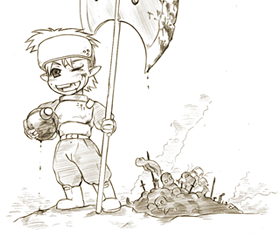
The Bellato sometimes confuse courage with justice. Freedom, justice and bravery are what they hold to be the central values of a life. To reach justice as they understand it, violence can — and should — be used, and in that case it counts as bravery. It is a serious flaw in this race, though it does not stop them winning a great many times. The Guild Tournament is a vivid example of those values at work.
In the beginning the Guild Tournament was not a competition to the Bellato at all. As a rule the game started in the centre of a settlement, and the goal was to take the ball from the opposition first and carry it to the gates of another settlement. Contests like that looked more like war than sport. In that brutal game players could seriously wound, or even kill, an opponent.
From the very beginning these contests, fought by hired mercenaries, were hard enough to bring out everything a team had in it. The Guild Tournament brought enormous profits, but it also demanded heavy spending: hiring more experienced players, buying equipment, healing the wounded. There were no restrictions on what a player could do — these were brutal competitions without rules.
Even so, Guild Tournaments became very popular among the Bellato. The most important match was always held to mark the Day of the Federation's Founding. Great numbers of players took part, many more came simply to watch, some placed bets and then cheered their team on. The winning guild received a generous settlement from the losing town.
Raising courage and manhood is a noble business, but avoiding casualties and bloodshed along the way calls for clearly written rules and an agreed set of regulations. The Bellato government recognised the explosive energy the Guild Tournament released into the life of the Federation, and decided to bring order to the game and turn it into a sport.
STEP 2
| | |

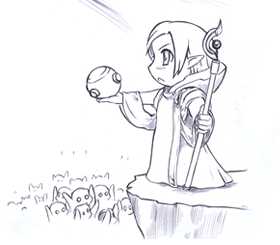
The Cora are by nature a quiet people, peaceful in ordinary times, and if they argue at all it is about Decem and his will. To hard sports and games they prefer peaceful contemplation of nature, and they value silence highly.
For all that, the Alliance was actively widening its influence, drawing more and more followers under its banners. The absolute mysticism in the Cora's behaviour and turn of mind inspired both fear and respect in the other races. So the Alliance's missionaries decided that the best way to attract new followers of Decem was a game.
In other words, the weight given to "the culture of play" in drawing closer to other races and peoples was raised. To spread Cora's culture and Decem's teaching, the old culture of play would not do. What was needed was not a solitary game but a shared one, which would help people come together naturally.
They took as their basis a game with a small ball played by Bisk children. So that two, three, or even ten or twenty could play it freely, the missionaries drew up a set of rules founded on the basic teaching of Decem. Playing by those rules, children learned the foundations of the teaching of the god of numbers, Decem, as a matter of course.
The ball game became popular not only in the Alliance's colonies but on the Cora homeworld too. The young, who were the Cora's main strength, turned their attention to this active, forward-looking game. But when the ball game and its famous star players began to overshadow faith in Decem, the elders of the Alliance decided to put a stop to the matches. The ball game was declared heretical and contrary to Decem's teaching.
The young people's love for the ball game, however, had no intention of fading. In the distant colonies and in the places the elders' influence did not reach, the game grew into large competitions. In the end Jiz Dain, head of the most influential and powerful military clan Jiz, put the question of whether the ball game contradicted the teaching of Decem before the official religious court. The elders could not withstand the pressure from Jiz Dain, who had the weight of an entire young generation behind her. The ruling was that the ball game does not contradict the teaching of Decem and, more than that, is a game that shows his will. That settled the conflict. It was decided that there is nothing wrong with the game being played in Decem's name.
STEP 1 | STEP |
| | |

Is it possible to create a form of training as close as possible to real combat and at the same time as safe as possible for those taking part? Accretian scientists on the laboratory planet Albarium discussed that question for a long time. After a great many experiments they arrived at an ancient form of war — what is called "sport". Sport was precisely the ancient form of struggle best suited to the problem.
Their distant ancestors had driven a ball across a field and put it into the opponent's gate, and that simple game carried such a charge of excitement that it could drive all good sense and sobriety of mind out of a head.
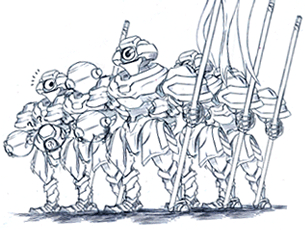
The scientists noticed this and decided to run an experiment with children whose bodies had not yet been mechanised. The ferocity with which the children fought for the ball exceeded every forecast: they fought for the win with a strength and energy that did not even need amplifying. Satisfied with the result, the scientists of Albarium set about actively researching how the principle of "the ball" and "the group battle" could be combined with war.
At first the game was presented to children as an ordinary ball game, a way of building a sense of the collective and teaching them to strive for victory. Remarkably, the game raised even greater enthusiasm among adults who had already been mechanised. In its early form the game of harpastum was a training battle with simple rules — carry the ball into the opponent's territory. But the Accretians added various elements of military strategy and the art of war to those simple rules: for the sake of victory you may not retreat, even when the one attacking you is far stronger. That produced a result no ordinary training fight could show.
The Empire, however, valued the lives of its subjects highly, and harpastum, which set the fire of excitement burning, became one of the causes of a breakdown in public order. Because of this the research had to be broken off. The chief opponent of the game was a tribune of the Council named Kracius, who argued that research of this kind hindered the unity of the Empire and was extremely dangerous. His active opposition put harpastum in danger of disappearing. But the military commanders, who had to wage war on the Cora and the Bellato every day, had already seen for themselves what harpastum did for fighting spirit in real combat, and they also knew that restricting or banning the game would do nothing for the Empire's victory.
STEP 2
The Guild Tournament
There is a story that goes like this. General Julius, a supporter of harpastum, and the people's tribune Kracius, its fierce opponent, once came into conflict. The Emperor Hadrian Caesar ordered each of them to take ten soldiers and train them for one month by his own methods, so that after a month it could be seen whose soldiers had become stronger. The month passed. General Julius's warriors had spent it enjoying harpastum alongside their training, and that was exactly what let them smash the soldiers trained by the tribune Kracius to pieces. That victory put an end to the argument. Afterwards the Albarium laboratory went on working on the rules of the game, and in the end it was recognised as the best method of training the Empire's soldiers in the skills of war. Harpastum developed further as a military sport, one that strengthens the collective and raises fighting spirit as high as it will go.
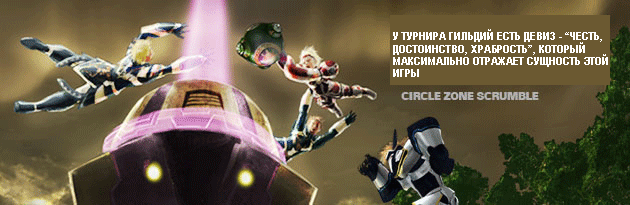
Later it became known that the Cora and the Bellato had similar games. For its own advantage — to demonstrate its military might and to stimulate its fighting spirit — the Accretian Empire decided to join forces with the other two races in drawing up the rules of a new game. That was how the sport called Circle Zone Scramble was created.
The gravity ball
The gravity ball is a device based on the technology of the Ancients, on what is called the "gravity stone". It is made so that it always stays at the same height and no magnetic or other field can affect it. Strike such a ball or throw it and it barely shifts at all, so the only way to move it somewhere else is to pick it up and run to the place you want. Passing or throwing the ball to a team-mate is impossible. The surest way to get the ball is to bring down whoever is holding it and take it.
Source: rfonline.ru (Innova, 2007–2009), recovered from the Internet Archive. original page